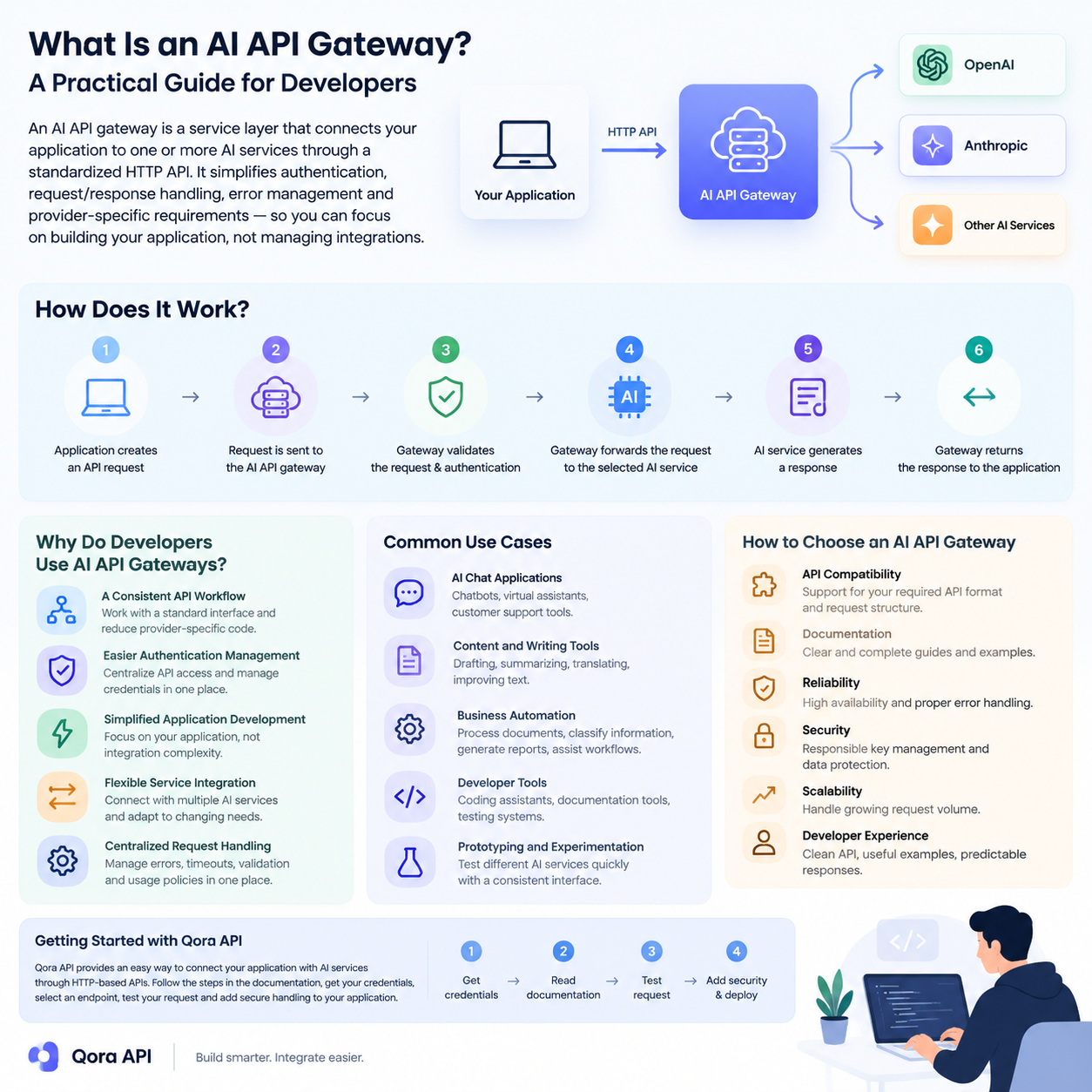
Short answer: the best AI API gateway in 2026 is the one that speaks the OpenAI protocol natively, adds well under 50 ms of routing overhead, fails over across at least three providers without application changes, and attributes every token of spend to a specific key or team.
As AI continues to reshape software development, choosing an AI API gateway has become a critical decision for developers and businesses. The gateway is the central hub for managing, routing and securing API calls to multiple AI services, streamlining integration and reducing complexity.
Table of Contents
- What is an AI API Gateway?
- How to Run a Gateway Evaluation
- Key Features to Look For
- Protocol and SDK Compatibility
- Latency and Throughput Overhead
- Failover and Reliability Guarantees
- Observability and Cost Attribution
- Security, Key Management and Compliance
- Common Use Cases
- Implementation Best Practices
- Migration Path and Rollback
- Cost Considerations and TCO
- Common Selection Mistakes
- Frequently Asked Questions
- Conclusion
What is an AI API Gateway?
An AI gateway is a specialized server that acts as an intermediary between your applications and multiple AI service providers. It provides a unified interface for accessing different AI capabilities, from natural language processing to image generation, through a single, consistent API.
Key benefits of using this technology include:
- Unified Interface: Access multiple AI providers through one API
- Cost Optimization: Route requests to the most cost-effective provider
- Reliability: Automatic failover when a provider experiences downtime
- Security: Centralized authentication and rate limiting
- Monitoring: Track usage, costs, and performance across all providers
An AI gateway is not a traditional API gateway with a language-model plugin bolted on. Traditional gateways assume short, stateless calls measured in milliseconds. LLM traffic streams for tens of seconds, bills by token, and depends on upstream providers that rate-limit without warning. See AI Gateway vs API Gateway: Key Differences and When to Use Each.
How to Run a Gateway Evaluation
Most teams pick a gateway from a landing page, which is how an undebuggable component ends up in the critical path. A two-week bake-off is far more reliable.
The three architectural options
Decide which shape you want before scoring vendors. Their cost and risk profiles differ fundamentally.
| Criterion | Direct provider integration | Self-hosted gateway | Managed relay |
|---|---|---|---|
| Protocol compatibility | One SDK per provider | You build the compatibility layer | OpenAI-compatible out of the box |
| Model coverage | Whatever you integrate | Whatever you configure | Broad, operator-maintained |
| Latency overhead | None | Low, depends on region | One extra network hop |
| Failover | Custom retry per provider | You build the health checks | Built in, often multi-region |
| Observability | Split across dashboards | Full control, you own it | Unified logs and cost views |
| Pricing model | List price only | List price plus infrastructure and on-call | List price plus a routing margin |
| Compliance | Depends on each provider | Strongest: data stays in your network | Depends on operator certifications |
The two-week plan
Rate each option from 1 to 5, then weight for your context. Fix the weights before any demo, or they bend toward whichever tool demoed best.
- Days 1 to 2: replay 500+ frozen production prompts through each candidate.
- Days 3 to 4: measure time to first token at the 50th, 95th and 99th percentiles.
- Days 5 to 6: inject failures. Kill a provider mid-stream and confirm silent recovery.
- Days 10 to 11: audit logs. Can you reconstruct key, token count and cost from three days ago?
- Days 12 to 14: rehearse the exit and time how long rollback takes.
For routing-specific methodology, see How to Choose the Right AI Model: A Practical Model-Routing Guide.
Key Features to Look For
1. Multi-Provider Support
The best solutions support multiple providers including OpenAI, Anthropic, Google AI, Cohere and open-source models. This prevents vendor lock-in and lets you match models to tasks, so check how quickly new models appear after launch.
2. Intelligent Routing
Advanced solutions route requests automatically based on cost, speed, model capabilities or availability, ensuring optimal performance without manual intervention. Look for rules you can express declaratively and override per request.
3. Comprehensive Security
Look for API key management, rate limiting, request validation and encryption. Upstream provider keys should never reach your application code.
4. Usage Analytics
Analytics reveal usage patterns, costs and bottlenecks. The minimum standard is per-request records carrying token counts, latency, model, provider and a customer identifier you control.
5. Streaming Fidelity
A gateway that buffers streamed responses destroys a chat interface. Verify that server-sent events pass through incrementally and that client cancellation propagates upstream.
Protocol and SDK Compatibility
Compatibility determines how expensive the gateway is to adopt. An OpenAI-compatible endpoint means your existing SDK, retry logic and test fixtures keep working.
Check these before committing:
- Request and response shape: do tool calls, structured JSON outputs and multimodal blocks survive the round trip unchanged?
- Streaming semantics: are chunk boundaries and the terminal sentinel preserved, or does the gateway rewrite the event stream?
- Error codes: are upstream status codes passed through faithfully, or flattened into a generic 500?
- Header passthrough: can you attach custom metadata that appears in logs and cost reports?
- Non-chat endpoints: embeddings, speech, transcription and image generation are often forgotten.
The payoff is that switching providers becomes a configuration change rather than a refactor, as argued in How to Switch AI Providers Without Rewriting Your Code and OpenAI-Compatible API: One Key for GPT, Claude and Gemini.
Latency and Throughput Overhead
A gateway sits in the hot path of every request, so its overhead is a permanent tax. For LLM workloads that tax is usually negligible relative to inference time: a routing decision plus one extra hop typically adds single-digit to low-double-digit milliseconds, while a completion takes seconds.
What actually hurts is two failure modes. Buffering, where the gateway waits for a full response before forwarding it, turns time to first token from hundreds of milliseconds into the whole completion time. Connection churn, opening a fresh TLS handshake on every call, adds a round trip per request.
Measure overhead as a delta: run the same prompt directly and through the gateway, compare the 95th percentile of time to first token, and express it as a percentage of end-to-end latency. Anything under roughly five percent is invisible to users, a discipline shared with LLM Observability: Monitoring AI API Usage, Latency and Cost.
Failover and Reliability Guarantees
Failover is where a managed gateway earns its margin. Provider outages, regional capacity crunches and per-key rate limits are routine, and the gateway should absorb them without users noticing.
Evaluate failover on four axes: how failures are detected, how fast a provider leaves rotation, whether retries are safe, and how a request that already streamed partial output is handled. That last one matters most, because once the first token reaches the browser you cannot silently retry. Health checks must be active, not passive. A probe you can run yourself looks like this:
import os, time, httpx

def probe(model):
    t0 = time.perf_counter()
    r = httpx.post(
        f"{os.environ['GATEWAY_BASE_URL']}/chat/completions",
        headers={"Authorization": f"Bearer {os.environ['GATEWAY_KEY']}"},
        json={"model": model,
              "messages": [{"role": "user", "content": "ping"}],
              "max_tokens": 1},
        timeout=10.0,
    )
    return {"model": model, "ok": r.status_code == 200,
            "latency_ms": round((time.perf_counter() - t0) * 1000, 1)}
Run that on a schedule from the same region as your application and alert on two consecutive failures. It gives you a signal independent of the gateway’s own dashboard, which is what you want when the gateway is the suspect. Redundancy patterns are covered in How to Build a Multi-Provider AI Failover Layer for 99.9% Uptime.
Observability and Cost Attribution
If you cannot answer “which customer generated this spend” in under a minute, the gateway is not finished. Every request record should carry a timestamp, the calling key, the resolved model and provider, token counts, time to first token, total latency and status code.
Also test budgets and quotas per key, so a runaway integration cannot consume the month’s allowance before anyone notices, and confirm you can export raw records to your own warehouse for reconciliation.
Security, Key Management and Compliance
Centralised credential handling is the strongest security argument for a gateway. Provider keys live in one place instead of being copied into every service, CI job and laptop, and applications authenticate with scoped virtual keys you can rotate, revoke and rate-limit individually.
Ask these during evaluation:
- Where are upstream credentials stored, and how are they encrypted at rest?
- Can a virtual key be scoped to specific models, budgets and expiry dates?
- Is prompt content logged, and can that logging be disabled per key?
- What certifications does the operator hold, and do the data flows match your obligations?
Content logging deserves particular attention. Logging prompts is invaluable for debugging, but it creates a new store of customer data, which can change your compliance posture overnight. Decide deliberately, per environment. Key hygiene is covered in AI API Security: Protecting Keys and Preventing Abuse.
Common Use Cases
For Startups
Startups can experiment with different providers without committing to a single vendor, prototyping quickly while keeping the flexibility to switch as needs evolve.
For Enterprise
Large organizations use these gateways to standardize AI access across teams, enforce governance policies, manage costs centrally, and ensure compliance with data handling regulations.
For SaaS Products
SaaS companies add intelligent features without managing multiple provider integrations, and gain per-tenant attribution so AI usage can be metered or billed. See Metering and Billing AI Usage Per User: A Practical SaaS Guide.
Implementation Best Practices
When implementing your solution, consider these best practices:
- Start Small: Begin with one or two use cases before expanding
- Monitor Closely: Track performance metrics and costs from day one
- Plan for Scale: Ensure your gateway can handle traffic growth
- Implement Fallbacks: Design graceful degradation when services are unavailable
- Cache When Possible: Reduce costs and latency by caching repeated requests
- Version Your Prompts: Treat prompt changes as deployments with their own review and rollback
Migration Path and Rollback
Adopting a gateway should be a small change, and if it is not, that is itself a signal. The cleanest migration keeps your existing SDK and changes only the base URL and the key.
from openai import OpenAI
import os

client = OpenAI(
    api_key=os.environ["GATEWAY_KEY"],
    base_url=os.environ["GATEWAY_BASE_URL"],
)
Two environment variables, no import changes, no call-site rewrites. Roll out by routing a small percentage of traffic first and keep the direct provider configuration in place, so rollback is a variable change rather than a code revert.
Cost Considerations and TCO
AI API costs can quickly add up. A good gateway helps control expenses through:
- Intelligent provider selection based on pricing
- Request caching to avoid duplicate calls
- Rate limiting to prevent runaway usage
- Detailed cost tracking and budgeting alerts
Compare total cost of ownership rather than sticker price. The model has four parts: inference spend, gateway cost, engineering time and incident cost. Self-hosting looks cheapest on the first line and most expensive on the last two, because someone must own upgrades, scaling and the pager. A managed relay adds a margin on inference but can remove an entire on-call rotation.
Express the comparison in relative terms. If routing rules move a meaningful share of simple traffic to a cheaper model tier, the saving usually exceeds the gateway’s own overhead by a wide margin. Concrete techniques are in How to Reduce AI API Costs: A Practical Guide for Developers.
Common Selection Mistakes
- Choosing on price alone. The cheapest routing margin is worthless if the gateway buffers streams or drops tool calls.
- Skipping the failure drill. A failover path that has never been exercised is a hypothesis, not a guarantee.
- No exit plan. If leaving requires a refactor, you have replaced one lock-in with another.
Future Trends in Gateway Technology
The space is evolving rapidly. Emerging trends include:
- Edge Deployment: Running smaller models closer to users for lower latency
- Hybrid Models: Combining cloud and on-premise AI for sensitive workloads
- Agent-Aware Routing: Gateways that understand multi-step tool-use sessions rather than isolated calls
Frequently asked questions
Do I need a gateway for a single-provider application?
Not immediately, but the case strengthens quickly. The moment you add a second environment, team or model, centralised key management and per-key budgets pay for themselves.
Does adding a gateway meaningfully increase latency?
For typical LLM workloads, no. A routing decision and one extra hop add a low single-digit percentage of end-to-end completion time. The real risks are buffered streaming and connection churn, so test time to first token at the 95th percentile.
Is self-hosting cheaper than a managed relay?
It depends on how you value engineering time. Self-hosting removes the routing margin and maximises data control, but you own upgrades, scaling, monitoring and incident response. Teams without dedicated platform engineers usually find the fully loaded cost exceeds a managed margin once on-call time is counted.
How do I avoid vendor lock-in?
Insist on an OpenAI-compatible interface, keep prompt content and routing configuration in your own repository, and rehearse rollback before you need it. If reverting to direct provider calls is a two-variable change, you have not traded one lock-in for another.
Should the gateway log full prompts and completions?
That is a compliance decision, not a technical one. Logging content makes debugging easier, but it creates a new store of potentially sensitive data. Decide per environment, default to off in production unless you have a clear retention policy, and make the setting per key.
Conclusion
Choosing the right AI API gateway is essential for building robust, scalable, and cost-effective AI-powered applications. By providing unified access to multiple AI providers, intelligent routing, comprehensive security, and detailed analytics, a quality solution becomes an indispensable tool in your infrastructure.
Whether you are a startup experimenting with AI or an enterprise standardizing access across teams, investing time in selecting the right gateway will pay dividends in development speed, operational efficiency, and cost optimization. Score the options against a written rubric, run the failure drills, and confirm the exit path before you commit. A managed relay such as qoraapi.com is a reasonable default for teams that want OpenAI-compatible access to many models without operating the routing layer themselves.
More guides in the AI API series
Continue building your AI API stack: How to Handle AI API Rate Limits and 429 Errors · AI Embeddings Explained: Vectors, Similarity, and Building Your First RAG · AI API Security: Protecting Keys and Preventing Abuse · LLM Observability: Monitoring AI API Usage, Latency and Cost.